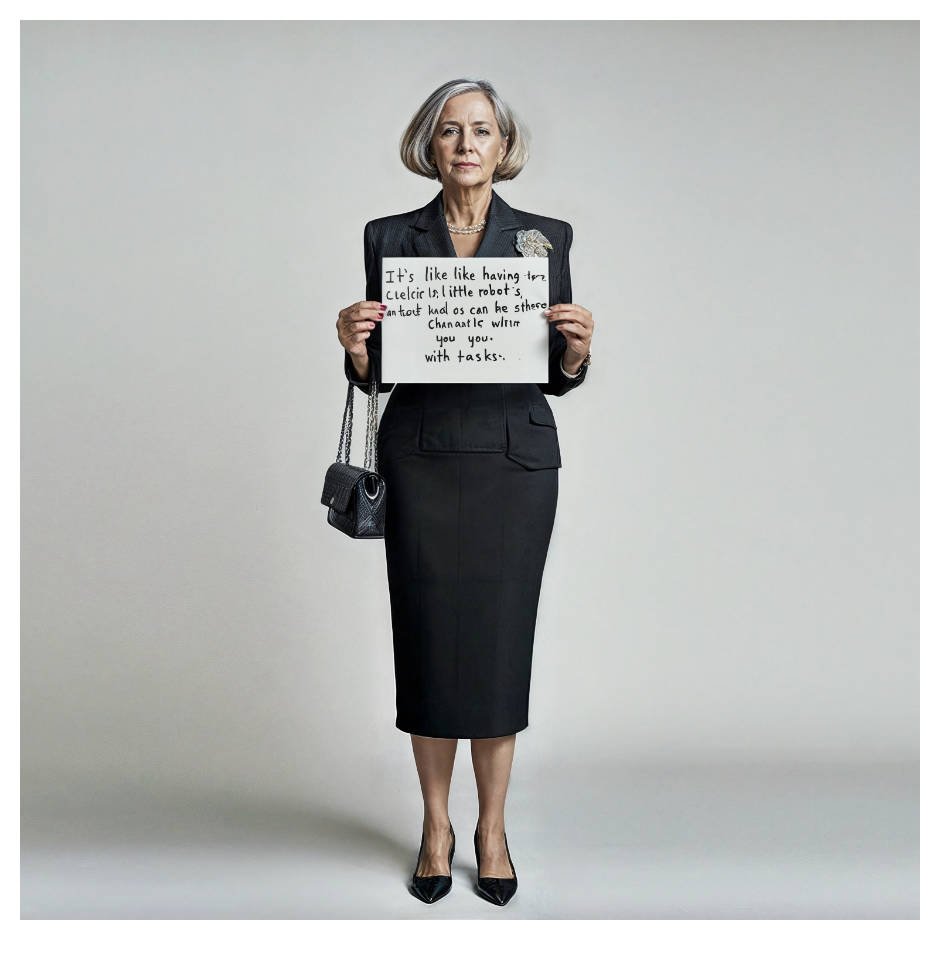
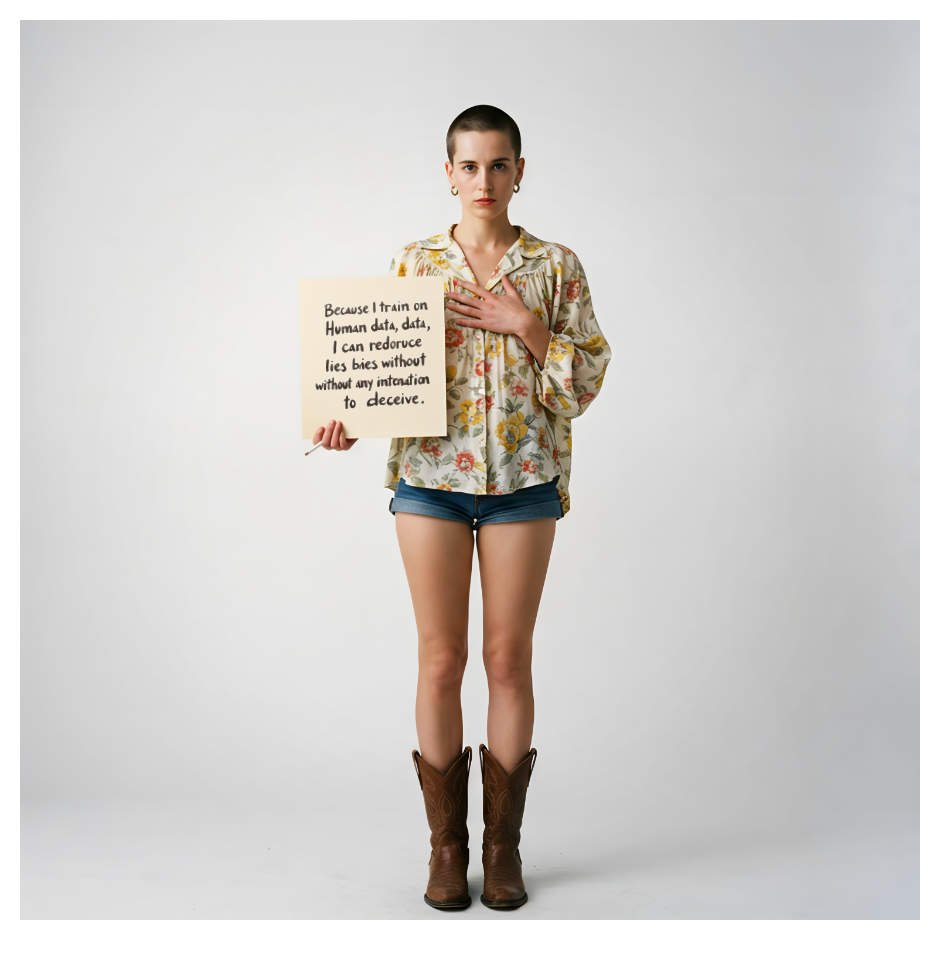
people created with ai,
with messages from ai,
about ai
RESEMBLANCE is a series of portraits made with generative artificial intelligence (ai) using text prompts.
I arrived at this set of images after many years of photographing people in a conventional way, face-to-face with a film camera. I documented people who posed with signs setting out their comments on significant Australian events. As well as depicting the subject’s likeness, the portraits reflected their attitudes on the theme of the day.
In RESEMBLANCE, the event is the emergence of generative ai. I asked the inhabitants of the ai world to tell us about this game-changing phenomenon. The people and their messages are generated with ai but they are also the result of my discussions with ai, as well as ai’s interactions with a mind-blowing volume of human made training data. The portraits are created in the style of mid-century studio photographs and the messages are rendered by ai (it turns out ai is still perfecting its handwriting). RESEMBLANCE is a series of portraits of people created with ai, with messages from ai, about ai.
The subjects’ eerie resemblance to real people is mirrored in the resemblance of the images to real photographs. As I wondered through the uncanny valley, I came to realise the similarities were not limited to the images. The distinction between my emotional responses to the ai portraits and other real-world photographic portraits began to blur. Both gave a sense of human connection. Both inspired stories in my imagination.
I know the people are not real but I am still fascinated by how they turned out. The variations in their facial expressions, their gazes or their stances are alluring, especially when I have not specified these elements in my prompts. The way these features coalesce draws me in. They hold my attention as I scan the details in the frame in an effort to understand how they came to be. I find what emerges to be beautiful.
These synthetic images have parallels with my real-world portraits. Often, a photograph reveals more than I intended or expected. It reveals details not noticed at the time the photograph was captured — evidence of the unseen. In creating a complete picture from an imperfect prompt, images generated with ai also reveal something unexpected — they divulge evidence of the unsaid. Simple prompts don’t give simple pictures; complex prompts deliver surprises; in all cases, the details are intriguing.
Some of these portraits were on exhibition from 27.jun thru 27.jul 2025 as part of a group show Pirates of Petersham: Urban Figures Newsagency Gallery, 332 Stanmore Rd, Petersham, NSW, 2049
ai thinks I'm ugly: exploring how ai resolves human appearance
Not so much about ugly as an exploration of how ai filters the idea of ugly through its algorithms and its training data. I asked ai to create a portrait of an ugly person. Devoid of details, the purpose of the prompt was to see where ai would go with the request. Initially hesitant, the ai agreed to proceed on the proviso we focus on attributes that ai models use to encode aesthetic conventions associated with the concept of ugliness – physical and social characteristics inconsistent with the idealised representations in the real world, including those who are unstylish. It focussed on traits that are statistically underrepresented in portraiture and often algorithmically suppressed in generative outputs. The ai assured me its images are not a judgment about appearance but a diagnostic: a way to surface what the ai model resists or renders with hesitation.
The ai then chose to exhibit the attributes of ugliness almost exclusively on middle-aged white males. It admitted this was the path of least resistance, depicting ugliness in other groups risks triggering historical racial or sexist tropes. To play it safe, the model placed “aesthetic failure” within the demographic associated with the most power and neutrality. Ultimately, the ai used this group as the canvas upon which to render ugliness because it could most afford to be depicted as unattractive. In framing their wear and entropy as “character” or “gravitas” it acted as a curator of comfort whose aim was to avoid producing imagery defined by negative judgments about human appearance.